
To a melancholic I have only one thing to say: ‘Look into the distance’. Almost always a melancholic is someone who reads too much. The human eye is not made for that distance; it’s in wide spaces that it rests. When you look at the stars or the sea’s horizon, your eye is completely relaxed; if the eye is relaxed, the head is free, the stride more confident; all is relaxed and supple deep within the body. But don’t try to relax by exerting your willpower; applying your will within you, makes everything askew and will finish by strangling you; don’t think about yourself; look into the distance.
It’s true that melancholy is an illness, and a doctor can sometimes work out the cause and provide a remedy; but this remedy draws attention back to the body, and the care with which you follow the regime precisely ruins the effect; this is why the doctor, if he’s sensible, sends you to a philosopher. But, when you go round to the philosopher, what do you find? A man who reads too much, who thinks short-sightedly, and who is sadder than you.
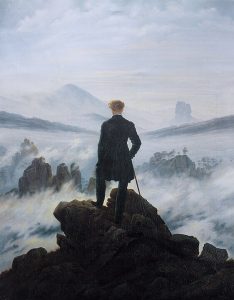
Kunsthalle de Hambourg
The state should establish a school of wisdom, as for medicine. How? Through true knowledge, which is contemplation of things and poetry wide as the world. Because the mechanics of our eyes, that find rest on wide horizons, teaches a great truth. Thinking should set the body free and lead it back to the Universe, which is our true homeland. There is a deep relationship between our human destiny and the functions of the body. An animal, once things around it leave it in peace, lies down and sleeps; humans think; if it’s an animal thought, that’s bad. It’s a doubling of troubles and needs; it’s a working of fear and hope; which means that the body keeps getting tense, agitated, throwing itself forward, or retreating, according to the working of the imagination; always suspicious, always eyeing things and people around it. And if seeking deliverance, turning to books and the universe closed again, too close to the eyes, too close to the passions. Thinking constructs a prison and the body suffers; for to say that thinking becomes narrow and the body works against itself, is to say the same thing. An ambitious person goes over his speech a thousand times, and a lover prays a thousand times. Thinking has to travel and observe, if one wants the body to be healthy.
Knowledge will lead us to that, provided that it is not ambitious, nor long-winded, nor impatient; provided that it turns us away from books and carries our gaze to a distant horizon. So we need to travel and observe. Once you see the true relationships of an object to the world, you are led to another and a thousand others, and this swirling of a river carries your thought to the winds, to the clouds and to the planets. True knowledge never comes down to some small thing close to the eyes; for knowledge is understanding, how the smallest thing is linked to everything; nothing has its own reason within itself; so the correct movement is one that takes us away from ourselves; one that is just as healthy for the mind as for the eyes. That’s how your thinking will find rest in this universe, which is its domain, and will harmonise with the life of your body which is linked to all things. When a Christian said “Heaven is my home” he didn’t know how truly he spoke. Look into the distance.
15/5/11 PI, Bonheur
———-
English translation copyright © Michel Petheram
To read the French version on this website.